
Being self-employed comes with one rather large risk. That risk being you don’t necessarily know where your next paycheck is coming from. Yes, you may have a a string of good months where you don’t have to worry, but what about when the work slows down or comes to a complete stop? When that does happen, here are two things you can do to help you weather those times.
The two things you need to take into account are 1.) how you handle every dollar that comes in the door and 2.) paying yourself a salary. If you do these two things. They will help set you up to survive the times when you have very little, if any, work coming in and when the tax man comes knocking.
On thing number one. Every dollar that comes in the door goes into, at minimum, three distinct buckets. Taxes, emergency savings and a checking account*. For every dollar, 30 cents, or 30%, instantly goes into a savings account** for taxes. The remaining 70 cents, or 70%, is broken into the other two buckets. 7 cents, or 10%, goes into an emergency savings account with the remaining 63 cents, or 90%, going into your checking account.
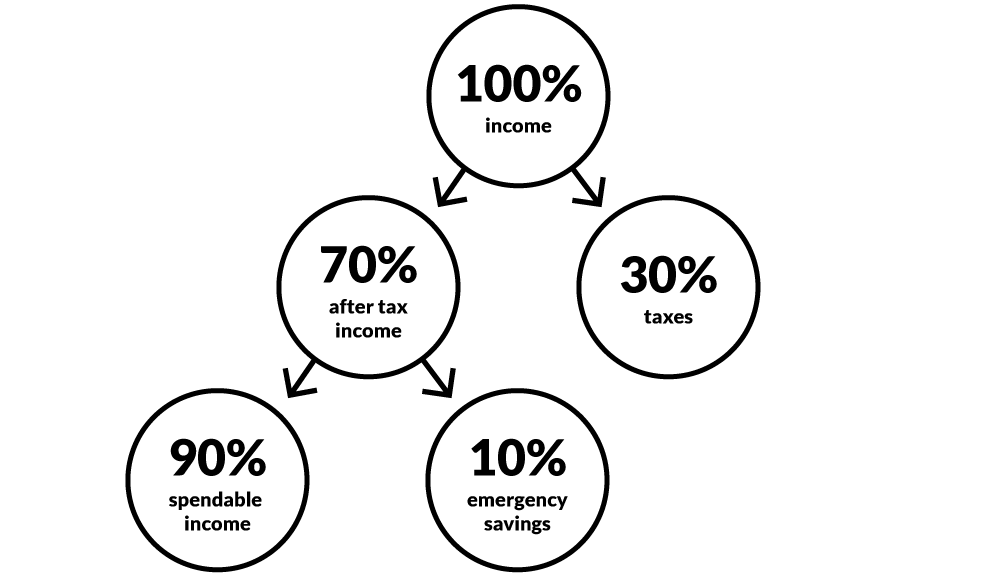
These three buckets are also only the starting point. If you want to create others buckets to help save for a new car, retirement or something else, by all means. And I’d highly suggest setting up a repeating automatic-transfers where you can. Setting and forgetting is always better and easier than having to move the money yourself.
This enables you not having to worry about the tax man knocking on your door. And putting away into an emergency savings will enable you to build up a cushion over time to help absorb any unexpected costs that pop up or help you survive a dry spell of work. And paying yourself a salary from a checking account keeps your spending in check when times are good.
On thing number two. Pay yourself on the 1st and 15th of every month because 1.) If you have a string of good months. That takes away a big pile of money staring you in the face saying “Spend Me!” 2.) If you have a dry spell followed by the string of good months. That will provide you a cushion to fall back on while you look for work. And this will, hopefully, keep you from having to tap into any emergency funds to pay your bills.
Now, with paying yourself a salary. You’ll need to figure out how much you spend in a year. If you don’t know where to come up with that figure. Sit down and take count of everything you pay out in a given month. Rent/mortage, gas, car payment, office space, everything. You may even want to look into products, like mint, that keep track of your spending over time. Then add, at least, 10–15% on top of that as things always pop up. Once you have your monthly expenses figured out. Follow the formula below to figure out how much your paycheck should be on the 1st and 15th.
(((monthly expenses*1.4)*12)*.7)/24 = your paycheck on the 1st and 15th
The last thing I’d suggest doing, if you have the two items above handled, is. Only keep, at most, three months of paychecks in the account you pay yourself from. Once you have more than that in the bank. Move it over to your emergency savings. I’ve found this helps short circuit the false sense of “Oh, I have enough money for four/five/six months. So I don’t need look for work right now.” and it builds your emergency savings even faster allowing you to weather a longer period of time when hardships arise.
*You can use a personal checking account, but after a while your bank will get suspicious if you bring in enough money.
** If you set up a high yield savings account for your taxes. That’ll next you at least an extra hundred bucks per year. It’s not much, but every penny counts.